


Every few years, finance gets hit with a new wave of panic. First it was spreadsheets. Then offshoring. Then automation. Now it is AI, and this time the anxiety feels sharper because the work AI is good at overlaps with a surprising amount of everyday finance work. A lot of the job still revolves around reading things, interpreting numbers, drafting analysis, explaining what changed, and turning scattered information into a decision someone can act on.
So the question is fair.
Will AI replace finance jobs?
The honest answer is no, not in the simple way people imagine. But it will change finance jobs fast, and some parts of the industry are much more exposed than others. The real risk is not that all finance roles vanish. It is that parts of finance get compressed, junior work would get thinner, and firms expect fewer people to do the same output with better tools.
One reason finance is right in the blast radius is that AI works best on cognitive, language-heavy, rules-heavy tasks. That is a big chunk of modern finance. Anthropic’s latest labor market research found that financial analysts are among the most exposed occupations when you combine what large language models can theoretically do with how they are already being used in real workplace settings. For me, this is not a fringe finding. It is exactly what you would expect from an industry built on research, documents, pattern recognition, commentary, and process.
But exposure is not the same as elimination. That distinction matters. In the same research, the company found no current impact on unemployment rates for workers in the most exposed occupations, though there is tentative evidence that hiring has slowed slightly for workers aged 22 to 25 entering those fields. That is a very different picture from “finance is dead.” It suggests something more subtle and more believable: firms are not ripping out entire departments overnight, but they may be getting more selective about junior hiring where AI can now absorb part of the entry-level workload.
That pattern shows up in other research too. The European Central Bank looked at firms across Europe and found no significant difference in overall job creation and destruction between businesses that use AI and those that do not. In fact, companies that make significant use of AI were about 4% more likely to hire additional staff, and firms investing in AI were nearly 2% more likely to hire than those that were not. The ECB’s interpretation is sensible: many firms still need people to implement, operationalize, supervise, and scale AI, especially when they are using it for innovation rather than just cost cutting.
That is the first thing people get wrong about this debate. AI does not always replace labor directly. Often it raises the output of the people already there. In finance, that can mean one analyst covering more companies, one compliance team processing more documentation, one operations group handling more exceptions, or one advisor servicing more client queries. From a worker’s perspective, that can feel like replacement even when payroll does not collapse, because the staffing math still changes. The bar rises. The team stays smaller. The junior bench gets thinner.
The second thing people get wrong is assuming all finance work is equally vulnerable. It is not.
The most exposed parts of finance are the jobs with a high share of repeatable digital tasks. Think back-office operations, middle-office process work, routine reporting, standard research memos, fraud triage, basic underwriting support, customer support, documentation review, internal knowledge retrieval, and parts of compliance. The Bank of England and FCA’s 2024 survey of UK financial services firms makes this concrete. Among 118 firms surveyed, 75% were already using AI and another 10% planned to use it within three years. The most common current use case was optimizing internal processes at 41%, followed by cybersecurity at 37% and fraud detection at 33%. Over the next three years, firms also expect significant growth in AI for customer support, regulatory compliance and reporting, and fraud detection
That should tell you where the real pressure is building. Not necessarily on the charismatic relationship banker or the senior portfolio manager making a high-stakes judgment call, but on the layers of work around them that are procedural, text-based, time-consuming, and expensive.
There is also a smaller shift happening inside legal, risk, and compliance functions in finance. The same Bank of England report found that foundation models account for 17% of all AI use cases, and that legal functions had the highest proportion of foundation-model usage among business areas. That makes sense. A lot of financial legal and compliance work depends on reading, classifying, checking, drafting, comparing, escalating, and documenting. AI is getting good at exactly those things. Not perfect, but good enough to change the economics of the work.
till, saying AI will transform finance is not the same as saying finance professionals are finished. The strongest counterweight is that finance is not just analysis. It is also trust, judgment, accountability, communication, regulation, and risk-bearing. A model can draft an investment note. It cannot carry fiduciary responsibility. A model can flag suspicious activity. It cannot own the final compliance decision. A model can propose a restructuring scenario. It cannot sit across from a board, absorb political nuance, and defend the recommendation when the room gets tense.
That is why the jobs most likely to get hit first are often the ones closest to codified knowledge and farthest from tacit judgment. Research from the OECD has pointed in a similar direction for years. In OECD data, higher AI exposure was associated with higher employment growth in occupations where computer use is high, suggesting that workers with strong digital skills can often use AI as a complement. But the same research also warns that AI can widen disparities between workers who can use these tools effectively and those who cannot.
That matters a lot for finance because the industry is full of people who look similar on paper. Same degrees. Same Excel skills. Same interview answers. Same valuation templates. Once AI handles more of the standard technical layer, differentiation shifts upward. Who has better judgment? Who asks better questions? Who catches what the model missed? Who can explain a messy situation clearly to a client, regulator, or investment committee? Who knows when a neat output is actually nonsense?
In that sense, AI may not erase finance jobs so much as expose weak finance professionals.
There is also a macro angle here. The IMF estimates that about 60% of jobs in advanced economies are exposed to AI, and roughly half of those may be negatively affected rather than complemented. Finance sits squarely inside that advanced-economy, cognitive-work zone. So yes, the industry is exposed. But “exposed” in the IMF framework does not automatically mean destroyed. It means AI is likely to alter tasks, wage dynamics, and bargaining power, especially in jobs built around information processing.
The broader labor market evidence also does not support a clean replacement story. The World Economic Forum’s Future of Jobs 2025 report says employers expect 39% of key skills to change by 2030, with AI and big data at the top of the skills list rising in importance. It also notes that roles such as fintech engineers are among the fast-growing jobs. In other words, even in a sector under pressure, some finance-adjacent work is likely to expand, especially where finance and technology meet.
That fits the more finance-specific WEF work too. In its 2025 report on AI in financial services, the Forum says 90% of leaders believe their organizations need significant adjustments or a total transformation of their reskilling strategy. That is not what you say when you think the future is simple headcount reduction. That is what you say when you know the work is changing faster than the workforce.
So what is the practical conclusion?
If you work in finance, the highest-risk posture is pretending this is overhyped and waiting it out. The second-highest-risk posture is using AI only as a shortcut machine, letting it do the thinking while your own judgment gets weaker. The winning posture is different. You want AI to take the dead weight out of your workflow while you build the pieces that are harder to commoditize: commercial instinct, regulatory understanding, communication, domain depth, client trust, and the ability to make decisions under uncertainty.
If you are early in your career, this matters even more. Junior finance roles have traditionally been built around repetition. Build the model. Clean the data. Pull the comps. Draft the note. Summarize the filing. Update the deck. Those tasks still matter, but they no longer guarantee job security because AI is increasingly capable of doing a first pass. That means junior talent now needs to become useful faster at the level above the task. Not just “I can build it,” but “I know what matters, what is wrong, and what decision should follow.”
So, will AI replace finance jobs?
Some, yes. Especially the narrow, repetitive, process-heavy slices of finance that can be standardized and supervised. Many more will be reshaped rather than removed. And the most likely near-term outcome is not mass extinction but compression: fewer people needed for the same work, higher expectations per employee, more pressure on junior hiring, and a larger premium on people who combine finance knowledge with AI fluency.
Finance is not disappearing but it for sure is becoming less forgiving. The people who survive this shift will not be the ones shouting that AI can never replace them. They will be the ones who quietly learn where AI is strong, where it is dangerous, and how to use it without becoming dependent on it.
That is usually how these shifts work. The tool does not kill the profession but it will redraw the line between average and exceptional.
What this means for high-finance careers
The AI conversation gets more interesting once you move beyond routine finance work and into fields like investment banking, private equity, and investment research. These roles are still exposed to AI in parts of the workflow, especially where the work involves drafting materials, reviewing documents, summarizing information, or pressure-testing assumptions. But the hiring bar in those fields is unlikely to get lower. If anything, it may get sharper. As more of the mechanical layer gets compressed, firms can spend even more time screening for judgment, technical fluency, and the ability to think clearly about risk. That is especially true in private equity, where interviewers are not just testing whether a candidate knows the mechanics of an LBO, but whether they can talk about a deal like an investor.
Related: Private Equity Technical Interview Questions: What They’re Really Testing
The Tools Finance Professionals Should Be Using Right Now
The pattern that keeps repeating when you talk to people who are adapting well to AI inside finance. They are not trying to avoid these tools. They are experimenting with them constantly. That does not mean blindly trusting every output. In fact, the people who get the most value from AI tend to be the ones who treat it like a fast junior analyst. Useful for a first pass. Dangerous if you stop thinking.
But ignoring these tools entirely is becoming harder to justify. The gap between professionals who know how to use AI and those who do not is already starting to show up in productivity. Here are a few categories of tools that finance professionals are quietly integrating into their workflows.
AI Research Assistants
Large language models have quickly become useful research companions for finance work. Tools like Claude, ChatGPT, and Perplexity can summarize filings, explain unfamiliar financial concepts, help draft notes, and quickly synthesize information across multiple sources.
The real advantage here is speed, imo. Instead of manually scanning dozens of documents to get context on a company or sector, analysts can use AI to produce a structured overview in minutes and then verify the details themselves.
Used correctly, this does not replace real analysis. It simply removes some of the mechanical work around gathering and organizing information.
Financial Data Platforms
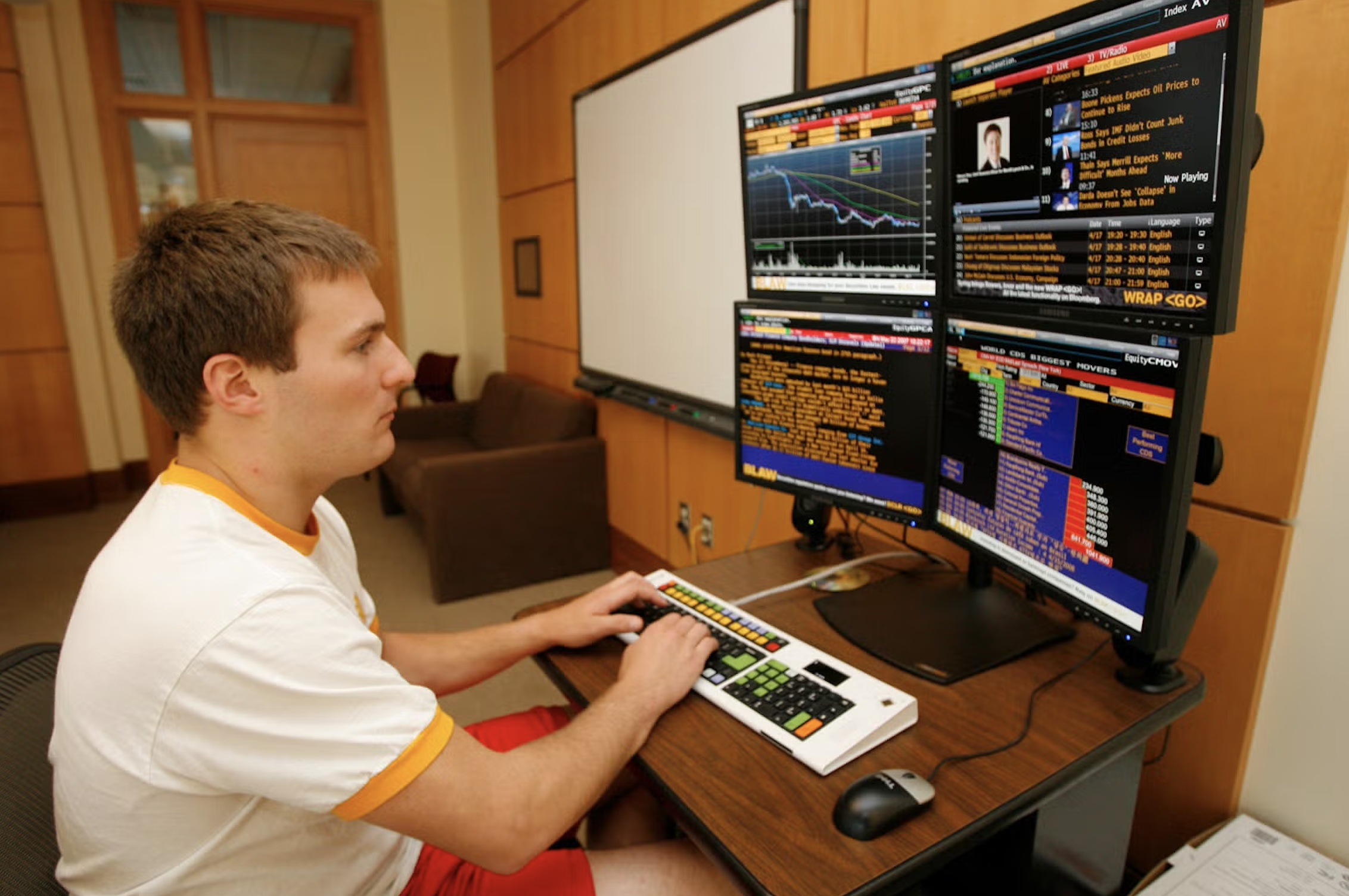
The traditional finance stack is not disappearing anytime soon. Bloomberg Terminal, FactSet, and S&P Capital IQ still dominate when it comes to reliable financial data, market feeds, and institutional analytics.
What is changing is how professionals interact with that data. AI tools can now sit on top of these datasets to help summarize trends, draft commentary, and speed up the interpretation phase. Learn more about how to use MCPs
In other words, the data platforms remain the foundation. AI is increasingly becoming the layer that helps turn the raw numbers into insights faster.
Workflow Automation Tools
A lot of time inside finance is spent on repetitive operational work: cleaning spreadsheets, formatting reports, preparing recurring analysis, or pulling information from multiple sources.
Automation tools like Zapier, Make, and Airtable are quietly becoming part of the modern finance workflow, especially in fintech, investment research teams, and internal analytics groups.
These tools allow professionals to automate routine tasks so they can focus on higher-value work such as decision making, risk assessment, and strategy.
AI-Assisted Writing and Communication
Finance is not just about numbers. A huge part of the job involves explaining those numbers clearly to clients, colleagues, or leadership.
AI writing assistants are starting to play a role here as well. They can help refine investor updates, draft internal memos, structure research notes, and improve clarity in written communication.
The best professionals use these tools as editing partners rather than ghostwriters. The goal is not to outsource thinking but to sharpen how the thinking is communicated.
Interview and Career Preparation Tools
Another subtle shift is happening on the career side of finance. As AI reshapes workflows, the expectations for candidates are evolving too.
Recruiters increasingly expect candidates to demonstrate not only technical knowledge but also judgment, communication skills, and the ability to explain complex financial ideas clearly.
That is why many candidates are now practicing interviews using AI-driven tools that simulate realistic finance interview questions and provide feedback on their answers. Platforms like InterviewPal allow candidates to practice technical and behavioral questions in a structured way, helping them prepare for roles where expectations are rising. In a more competitive hiring environment, preparation is no longer optional. It is becoming part of the baseline.

Staying Ahead Also Means Staying Curious
The biggest mistake finance professionals can make right now is treating AI as a passing trend.
Most of the people who will benefit from this shift are not necessarily the most technical. They are simply the ones who stay curious about new tools and experiment with them early.
In finance, information advantages compound quickly. The same is becoming true for productivity tools. The professionals who learn how to use them first will quietly pull ahead of the rest.
FAQs: AI and the Future of Finance Jobs
Will AI replace finance jobs completely?
No. The more realistic outcome is that AI changes finance work rather than wipes it out. Repetitive, document-heavy, and analysis-heavy tasks are already being sped up by AI, but roles that depend on judgment, accountability, and client trust are harder to replace. What is more likely is a shift in expectations: fewer routine tasks, more pressure to think clearly, communicate well, and use AI without relying on it blindly.
Which finance jobs are most exposed to AI?
The most exposed roles tend to be the ones built around structured analysis, recurring reporting, documentation, and repeatable workflows. That includes parts of financial analysis, accounting support, compliance operations, research support, and back-office finance work. These jobs are not necessarily disappearing overnight, but many of their core tasks are becoming easier to automate or accelerate.
Which finance careers are safer from AI?
Roles that rely more heavily on judgment, relationships, and high-stakes decision-making are generally less exposed in the near term. That includes portfolio managers, senior investment bankers, wealth advisors, and finance leaders who need to interpret ambiguity, advise clients, and own the final call. AI can support the work around these roles, but it does not easily replace the responsibility that comes with them.
Will AI replace financial analysts?
AI is more likely to reshape the financial analyst role than eliminate it outright. Analysts can already use AI to summarize filings, pull themes from earnings calls, and speed up parts of research. But firms still need people who can interpret the information, challenge assumptions, and explain what actually matters. The analyst role becomes more valuable when it moves beyond mechanical output.
Will AI replace accountants?
AI will likely automate more of the repetitive side of accounting, especially work tied to classification, reconciliation support, documentation, and standard reporting. But accounting also involves compliance, interpretation, review, and professional responsibility. That means the role is more likely to evolve than vanish. Accountants who learn to use AI to reduce manual work should be in a stronger position than those who ignore it.
Will AI replace investment bankers?
Not in the way headlines suggest. AI can help investment bankers with pitch materials, market research, precedent analysis, drafting, and early-stage preparation. But senior banking work still depends on persuasion, negotiation, relationship management, timing, and judgment under pressure. What AI may do is reduce some of the grind underneath the role, especially the repetitive analyst and associate layer, while raising expectations for everyone above it.
Is finance still a good career in the age of AI?
Yes, but the shape of a strong finance career is changing. The safest professionals will not be the ones pretending AI does not matter. They will be the ones who understand finance deeply and know how to use AI to move faster without outsourcing their thinking. The industry still rewards judgment, trust, and commercial understanding. AI just changes how the work gets done.
What skills should finance professionals learn now?
Finance professionals should get comfortable using AI for research, summarization, workflow support, and first-pass drafting. Just as important, they need to get better at verifying outputs, spotting weak reasoning, and knowing when human judgment matters more than speed. Technical literacy helps, but the real edge comes from combining AI fluency with sharper thinking and clearer communication.