


If you’re still Googling “internships near me” or mass-applying on the same five job boards, you’re already behind in 2026.
Internship hiring has quietly changed. Not dramatically. Not in a way that makes headlines. But enough that the old playbook no longer produces results for most students.
From the hiring side, here’s the uncomfortable truth:
Most internship roles never make it to the big boards. And the ones that do are usually flooded, late, or already internally decided.
This guide is written from the perspective of someone who has reviewed intern pipelines, screened early-career resumes, and watched where successful candidates actually come from today. No motivational talk. Just where interns are really being sourced in 2026, and how students should adapt.
Why traditional internship boards underperform in 2026
Let’s start with what’s not working well anymore.
Large job boards optimized for full-time hiring (LinkedIn, Indeed, Glassdoor) are structurally bad for internships:
- Internship roles have shorter hiring windows
- Recruiters close them quickly once “good enough” candidates appear
- Many companies don’t want to manage 800 student applications for a 3-month role
As a result, you’ll often see:
- Postings removed within days
- Intern roles reposted every year without real intent to hire externally
- Generic descriptions that tell you nothing about what the team actually needs
That doesn’t mean you should ignore these platforms entirely. But relying on them as your primary internship strategy in 2026 is a mistake.
ggregators that surface real internship demand
The most reliable internship signals now come from ATS-level aggregation, not marketing job boards.
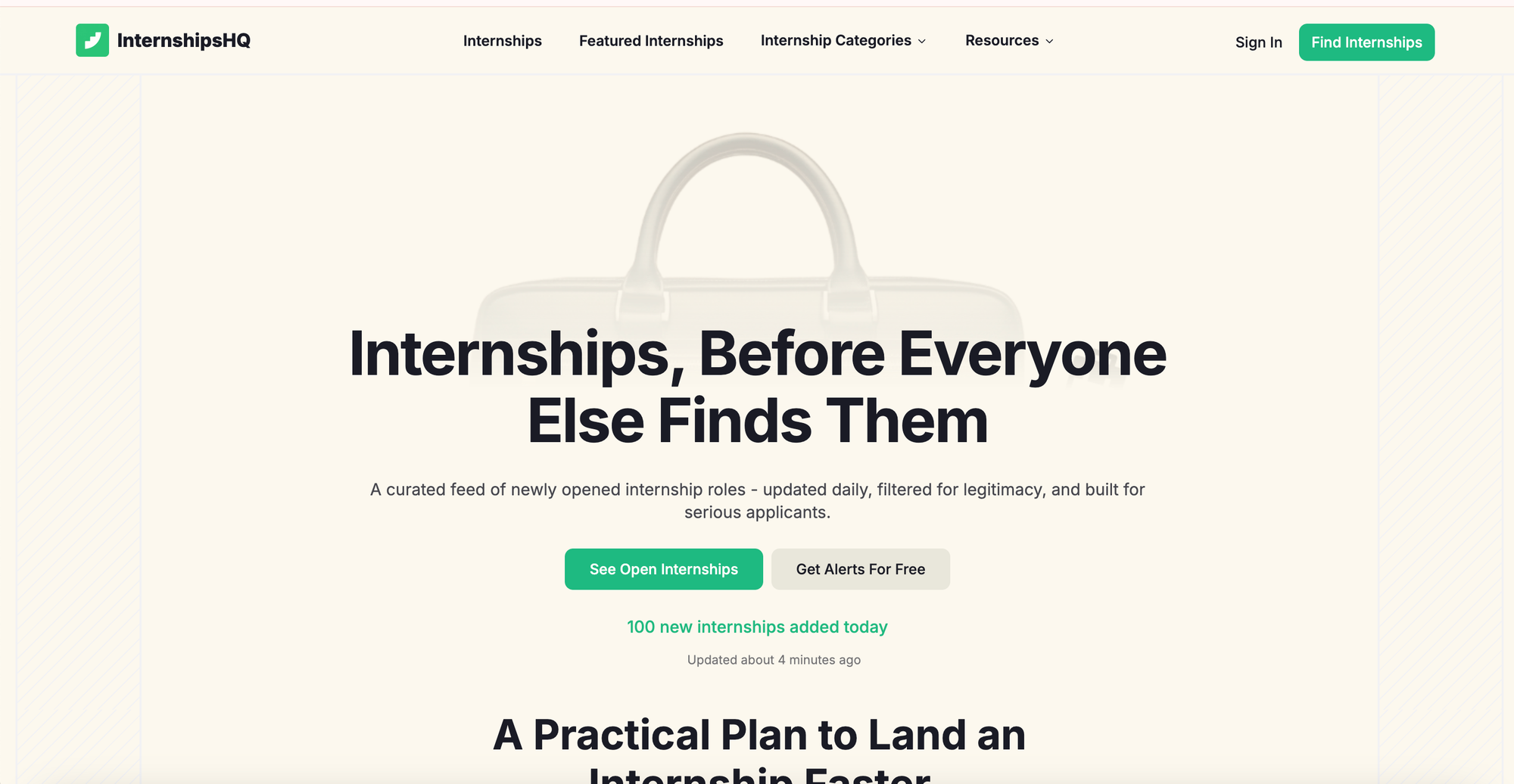
This is where tools like InternshipsHQ stand out.
Why recruiters like ATS-based aggregation
Many companies post internships directly on their own career pages using tools like Greenhouse, Lever, or Ashby. These roles:
- Are often live for a short time
- Don’t always get syndicated to large boards
- Reflect actual team demand, not HR placeholders
InternshipsHQ monitors these company-level postings and surfaces:
- Fresh internship openings
- Role-specific listings (engineering, data, marketing, finance)
- Companies that are actively hiring interns right now, not “collecting resumes”
From a recruiter’s perspective, candidates coming from these postings tend to be:
- Earlier in the funnel
- Less commoditized
- More relevant to the specific team
That alone increases your odds.
University career portals (still underrated, still misunderstood)
Most students treat their university career portal as an afterthought. Recruiters do not.
Many companies- especially mid-sized firms, only post internships through university partnerships. Reasons include:
- Lower noise
- Better graduation-date filtering
- Stronger visa clarity
- Higher conversion to full-time hires
What students miss is how to use these portals strategically.
Recruiter tip:
Search by employer, not just role.
If a company posted one internship through your university portal last year, there’s a strong chance they’ll post again, often without advertising elsewhere.
Track those companies. Set alerts. Be early.
Alumni-driven internship pipelines (the quiet advantage)
This is uncomfortable advice because it’s not “fair.” But it’s real.
A significant portion of interns in 2026 come from:
- Alumni Slack groups
- Department mailing lists
- Informal referrals
From a recruiter’s side, this happens because:
- Alumni candidates convert faster
- Cultural risk is lower
- Teams trust recommendations over cold applications
How students should adapt
You don’t need to ask for a referral outright. That rarely works.
Instead:
- Reach out to alumni with specific curiosity about their role
- Ask what their team looks for in interns
- Ask how internship hiring actually works at their company
When an internship opens, you’ll often hear about it before it’s public. Don’t worry if your academic workload seems too heavy to balance with your career goals. You can always get professional assignment help, which will allow you to complete your studies effectively while excelling in your internship at the same time. Ultimately, learning to manage your time and prioritize tasks is a crucial skill for any future professional
Project-based internships hidden in plain sight
In 2026, many internships are not labeled “internships.”
They appear as:
- Contract roles
- Temporary assistants
- Part-time project contributors
- “Junior” or “Associate” titles with flexible requirements
Recruiters use these labels to:
- Avoid intern program overhead
- Hire fast
- Test candidates before committing
Students who only search for the word “intern” miss these entirely.
What to search instead
Look for keywords like:
- “contract (3 months)”
- “project-based”
- “part-time student”
- “temporary support”
Then read the description carefully. Many of these roles are effectively internships with better exposure.
Startup ecosystems and founder-led hiring

Early-stage startups rarely run formal internship programs. But they hire interns constantly. Checkout startup job boards like WellFound.
Where these roles show up:
- Founder Twitter/X posts
- Startup newsletters
- Accelerator demo days
- Community job boards (YC, On Deck, local hubs)
From a recruiter standpoint, startup interns who succeed usually:
- Reach out directly
- Show relevant work samples
- Understand the company’s stage
This is less about volume and more about fit.
Preparing for internship interviews is now half the battle
Finding internships is only one side of the equation. The other is passing increasingly compressed interview processes.
Many teams now:
- Interview interns in one or two rounds
- Ask practical, role-specific questions
- Expect clearer answers than before
This is where tools like ours quietly help.
InterviewPal allows students to:
- Practice real internship interview questions
- Generate likely questions from a job description
- Identify gaps in their answers before speaking to a recruiter
From the hiring side, candidates who’ve practiced this way sound:
- More structured
- More specific
- Less rehearsed in a bad way
That matters more than students realize.
How strong internship candidates actually think in 2026
The best internship candidates I see don’t “apply everywhere.”
They:
- Identify where real demand exists
- Enter the funnel early
- Prepare intentionally for interviews
- Treat internships as stepping stones, not lottery tickets
Tools like InternshipsHQ help with step one.
InterviewPal helps with step three.
Neither replaces effort. But both reduce wasted motion.
Internships are no longer about who applies the most.
They’re about who shows up early, prepared, and relevant.
In 2026, that means:
- Smarter sourcing.
- Fewer platforms, used more intentionally
- Treating interviews as a skill, not a formality
If students adjust their strategy accordingly, internships stop feeling impossible, and start looking predictable.
And predictability, in hiring, is everything.